

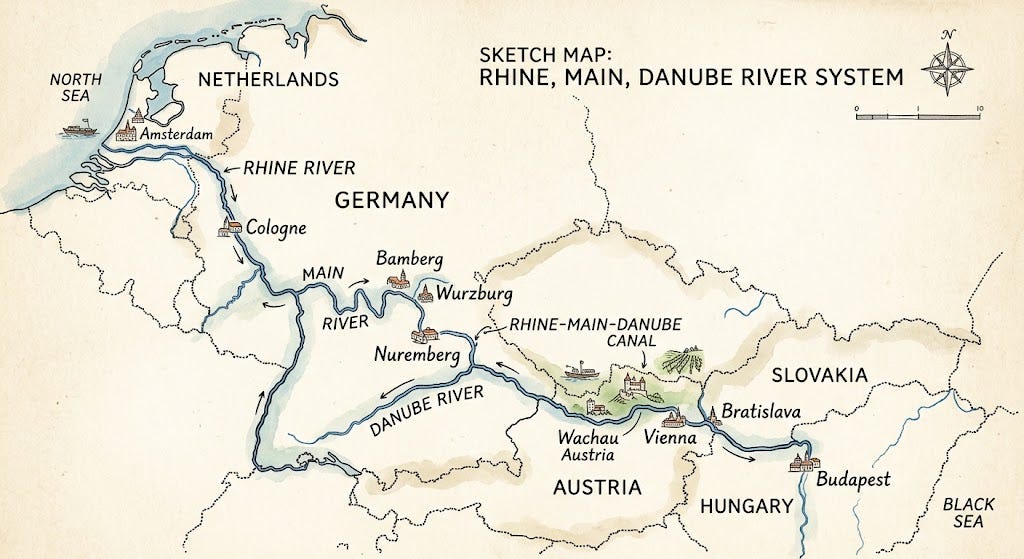
Travelling across Europe by river boat along the Danube, Main, and Rhine gives you a front-row seat to European cycling culture. It also drops you straight into major city centres for the inevitable guided walking tour. While everyone else was looking up at cathedrals, I spent most of my time watching and photographing people on two wheels through Budapest, Bratislava, Vienna, Nuremberg, Prague, and Cologne—before finally finishing up in Amsterdam.
Amsterdam, of course, is on another cycling planet altogether. It is fantastic for people-watching and photographing bikes, and cycling always takes priority over cars. The real eye-opener in Amsterdam is the suburbs: quiet, low-key, threaded with canals and birdlife, where modest living spaces make sensible density and easy cycling feel effortless. Amsterdam is 20 years ahead of these cities and Sydney, a 200+ pictorial story for another day.
Outside of Amsterdam, the standout feature across all these river cities was the magnetic appeal of their cycling waterways. In places like Vienna and Cologne, the riverbanks were absolutely alive with cyclists. The bridges across the big rivers almost always offered dedicated, quality paths on both sides with decent on- and off-ramps. Commuters and leisure riders would cruise along the river trunk paths and then dart straight into town centres where car traffic was mostly calmed or restricted. The inner cores themselves were a bit of a mixed bag of cobbles and shared zones, but the river boulevards were always the go to’s.
That contrast got me thinking about how Sydney stacks up.
In many ways, Sydney’s suburban rides and shared paths (aka Bourke St, Greenway) are actually far more lively and dynamic than the non-river paths in many of these historic European towns. We have great pocket parks, bustling creek paths, and leafy parklands that locals use every weekend.
What Sydney lacks is that one signature tourist cycle trail—a continuous, world-class cycling attraction that instantly anchors the city on the international cycling map. Europe has iconic, contiguous river routes along the Danube and Rhine that draw visitors from around the globe simply to ride for a day or a week. They also draw in the locals in huge numbers.
Sydney has the waterways, the climate, and the scenery to match anything in Europe. We have plenty of great individual rides, but what we need now is that contiguous, unforgettable river-to-harbour spine that makes visiting cycle tourists say: “I’m coming to Sydney, and the first thing I’m doing is hiring a bike.”
Budapest, the capital of Budapest, has a city population of roughly 1.7 million people, an area of 525.1 square kilometers, and a population density of about 3,209 people per square kilometer. Cycling featured a fab cycleway on the Pest side, lots of folks just riding anywhere on the Buda side and a big car free Margaret Island.
Bratislava (the capital of Slovakia), the city has an estimated population of about 480,000 residents, a total area of 370 square kilometers, and a population density of roughly 1,300 people per square kilometer. Major employers include Volkswagen and Slovnaft. Our highlight was a super fun ride in an ‘85 Skoda with our own driver and guide. We also rode along the Danube which was terrifc.
Vienna has a population of over 2 million people, a land area of 414.9 square kilometers, and a high density of roughly 4,890 people per square kilometer. Public administration, healthcare, and service-sector enterprises serve as the capital's largest collective employers. Totally classy place but as soon as you leave the waterways, the cycling options are just ok unless it is a one way road for cars.
The Danube is a wonderful river, it warmed my soul to look out and see birds and cyclists all the time. Though I only sampled bits and pieces of the Danube Riding, I was looking at the map as we went along. It may be a continous ride but out of the towns, it wasn’t alway obvious where the track was or even what side of the river you were mean to be on. Here are photos from a couple of days riding.
Nuremberg has a population of 550,000, a density of roughly 2,700 people per square kilometer, and covers a total area of 187 square kilometers. Its largest industrial employer is Siemens, which maintains a massive regional workforce alongside key public institutions like the Federal Employment Agency. This city wasn’t on a major river, the water on the Maine was running out in the drought so we were travelling to another boat by bus (Yawn).
Interesting non observation. Not many food delivery bikes in these cities.
Würzburg has a population of about 133,000 people, a population density of roughly 1,500 people per square kilometer, and covers a total area of 88 square kilometers. Its largest major employers are the University and the local city administration, alongside key industrial and manufacturing employers like Brose. Most of these pictures were from river riding by Garry
Bamberg, Germany has a population of about 77,200. It covers an area of 55 square kilometers. The population density is roughly 1,414 people per square kilometer. The largest employer in the city is Bosch, which runs a major manufacturing plant there.
Cologne has a population of over 1 million people spread across an area of 400 square kilometers, resulting in a high population density of roughly 2,700 people per square kilometer. Major employers include Ford Europe, REWE Group, and RTL Group. I surprised the night desk on the river boat when I asked to take out the folding ebike at 6:30am. A wonderful place to ride along the river.
Conclusion
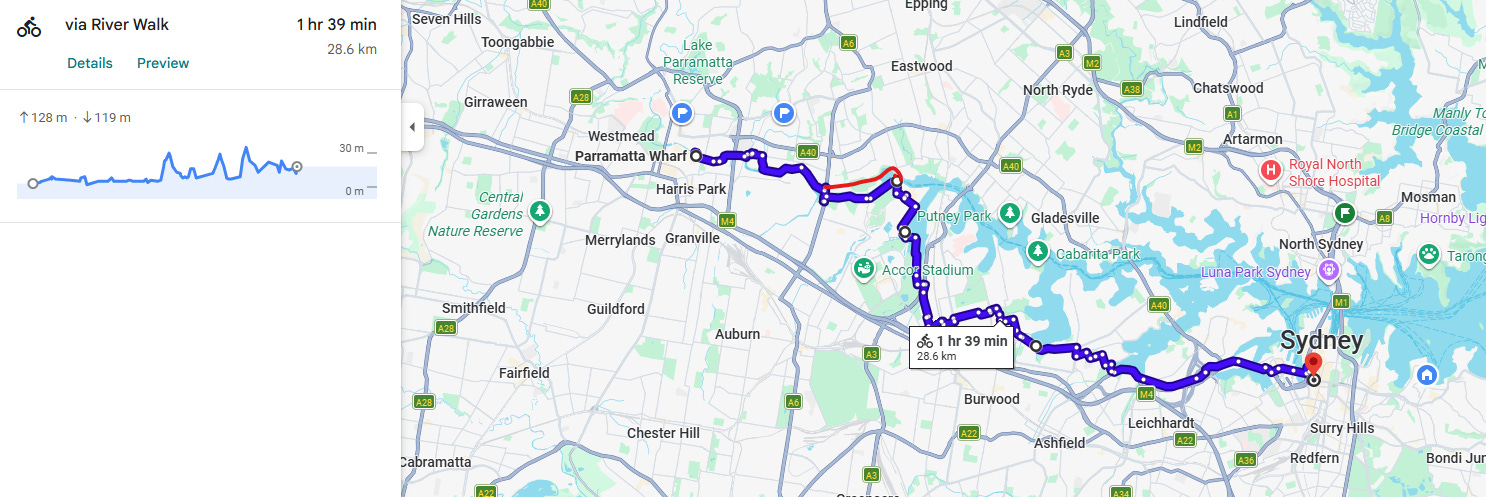
Sydney needs a useful working cycle trail that will be a feature of cycling tourism in NSW. As much as this humble scribe wants the Greater Sydney Bike Trail to be that track, that would be a decent commitment. What we need now is a trail that takes us along the Harbour and Parramatta river where possible, goes near the stations of the city-west metro and passes the wonderful Greenway and goes over the new tram bridge that is being built in Olympic Park. A total ride of just under 30km from city to city as per the sketch below. More on this topic here
On a different scale: Sydney is Australia's largest city with an estimated population of over 5.6 million. Greater Sydney covers an area of roughly 12,500 square kilometers with an overall regional density of about 449 people per square kilometer, while the inner City of Sydney local government area covers 27 square kilometers with a much higher density of over 9,000 people per square kilometer.
Further exploring
The track suggested above is pretty much what you get on the once a year car free October Spring Cycle
What about Sydney’s top ten rides? Maybe one of these becomes the NSW Government promoted Tourist Riding Mecca.
There are several trails that will eventually qualify as the “Mecca trails”, including the Northern Rivers, Monaro and New England Rail Trails, but unfortunately, none of them are in Sydney (unsurprisingly).
If they ever get the ferry running from La Perouse to Kurnell there will be a great loop possibility around Botany Bay.
Parramatta to Maroubra and Kurnell just about possible now via Olympic Park, Powell’s Ck, Cooks River and Botany Bay.
Windsor to Wisemans for the more adventurous, on the mighty Hawkesbury, though not on a path.